








Growing broccoli sprouts at home: guide & harvest


Why do broccoli seeds start off in the dark when sprouting, while cress gets going straight away on a bright windowsill? The answer lies in the seed itself: broccoli is a dark germinator. It's exactly this quirk that decides whether your batch turns into crunchy broccoli sprouts or a failed experiment.
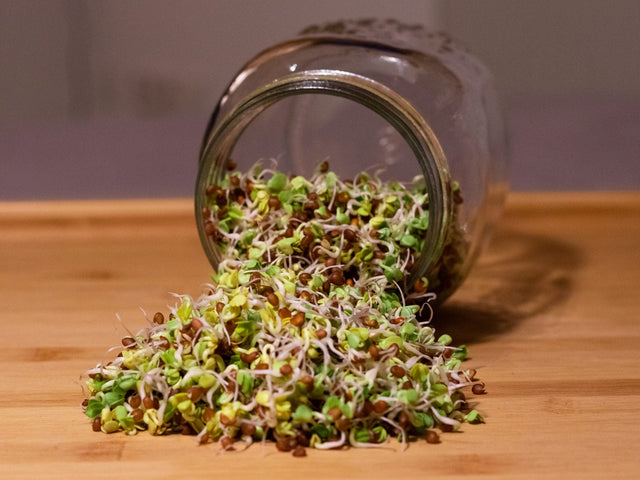
Broccoli sprouts are easy to grow in a sprouting jar as long as you keep an eye on the soaking time, the dark phase and the rinsing rhythm. Here you'll learn step by step how to grow them successfully, when to harvest and how to use the sprouts in the kitchen.
At a glance
- Broccoli is a dark germinator: keep it in the dark or in the fridge for the first few days
- Soak one to two tablespoons of seeds for 8 to 12 hours, then rinse at least twice a day
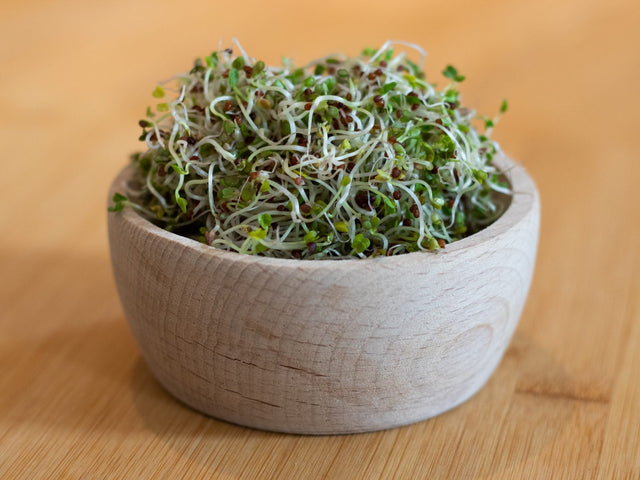
- Broccoli sprouts are ready to harvest after about 3 to 7 days, at a length of about 2 to 5 centimetres
- Use special sprouting seeds, not ordinary garden seeds
Broccoli as a dark germinator: why the first few days are crucial
Broccoli is one of the plants that prefer to start germinating without light. So keep the jar in the dark or in the fridge for the first few days.
Fridge or dark drawer: both work
For the dark phase, a lightproof drawer in a kitchen cupboard works just as well as a spot in the fridge. The only important thing is that no light reaches the jar, and that you still remember your rinsing rhythm even when the jar is out of sight. An alarm on your phone helps you not to forget the rinsing times in the early stages.
Tip
During the dark phase, put the jar somewhere you see it every day, for example on the worktop under a tea towel. That way you won't forget to rinse, even though no light is allowed in.
Seedlings, sprouts, microgreens: what's actually the difference?
Seedlings are the first visible stages of a plant after the seed has swollen and consist of a radicle and a shoot. As soon as the first seed leaves appear, they become sprouts, which are ready to harvest after a few days depending on the plant species.
Microgreens go one step further: they grow for one to three weeks and are then cut directly above the root once at least two green leaves have formed in addition to the seed leaves. Because they form more leaves, they are a stronger green than sprouts.
Why broccoli sprouts are harvested at the sprout stage
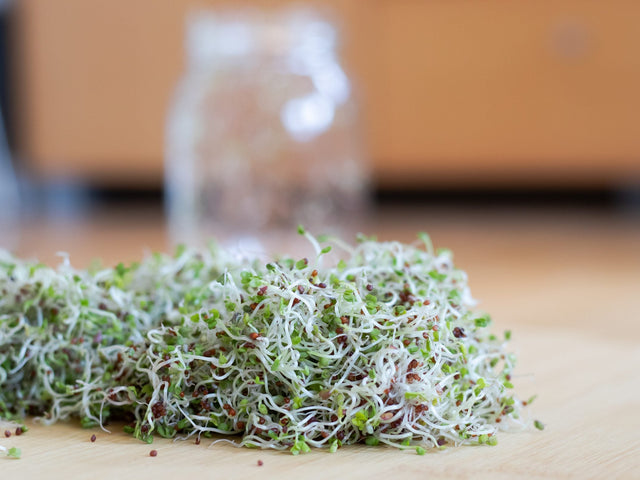
Broccoli can be harvested at the sprout stage, i.e. as soon as the first seed leaves have appeared and before true leaves develop. This is the case after about three to seven days. If you want to let broccoli grow longer, grow it on as a microgreen – the cress sieve is better suited to this than the jar.
| Stage | Time | Feature |
|---|---|---|
| Seedling | shortly after soaking | radicle and shoot visible |
| Sprout (broccoli) | after about 3 to 7 days | seed leaves developed, 2 to 5 cm long |
| Microgreen (broccoli) | after 1 to 3 weeks | at least two green leaves in addition to the seed leaves |
How do you grow broccoli sprouts step by step?
First you soak the seeds, then comes regular rinsing during the dark phase, and finally the seeds continue to grow in the light until they are ready to harvest. The whole process takes about three to seven days and can be done with a simple sprouting jar.
-
Soaking
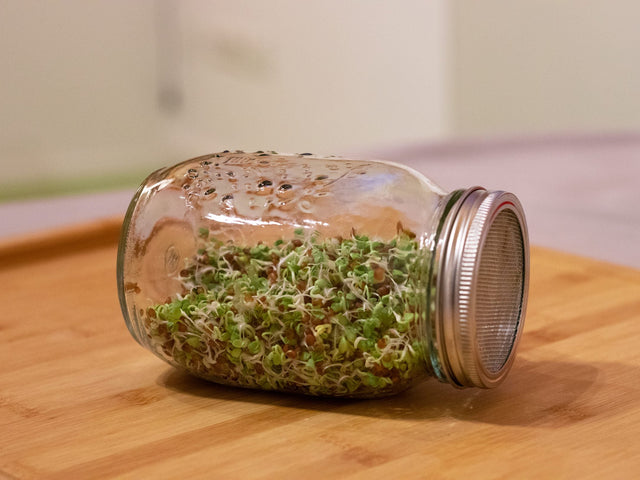
Put one to two tablespoons of broccoli seeds in the sprouting jar; the bottom of the jar should only be loosely covered. Fill with water and leave to soak for 8 to 12 hours. -
Draining and putting in the dark
Pour off the soaking water, place the jar at an angle to drain and put it somewhere dark or in the fridge. -
Rinsing (days 1 to 2)
Rinse with clean water at least twice a day, drain well and put it back in the dark. -
Bringing into the light
As soon as the first seed leaves appear, move the jar to a bright spot out of direct sunlight and keep rinsing at least twice a day. -
Harvesting
Harvest after about 3 to 7 days, when the sprouts are about 2 to 5 centimetres long. Rinse one last time, drain well and store in the fridge.
Typical beginner mistakes
Typical problems are caused by rinsing too rarely or by conditions that are too damp without sufficient draining. If water is left standing in the jar, there is a lack of oxygen and unwanted microbes get the upper hand. So after each rinse, place the jar at an angle so the water can drain away completely.
Good to know
If the sprouts smell musty or look strange, this indicates unwanted microbes or mould. In that case, don't eat the batch.
Time-lapse: how broccoli sprouts grow
Which sprouting jar and accessories do you really need?
For broccoli sprouts, a simple sprouting jar with a sieve or mesh lid is all you need, as it's easy to empty out and refill.
Amount of seed and equipment
In a sprouting jar, one to two tablespoons of seeds are often enough; the bottom of the jar should only be loosely covered. More seeds don't automatically mean a bigger yield – seeds sown too densely get in each other's way as they grow and drain less well.
What you need for broccoli sprouts
- Sprouting jar with a sieve or mesh lid
- Sprouting seeds for broccoli
- A dark spot or fridge for the first few days
- A bright spot out of direct sunlight for the light phase
- Clean water for daily rinsing
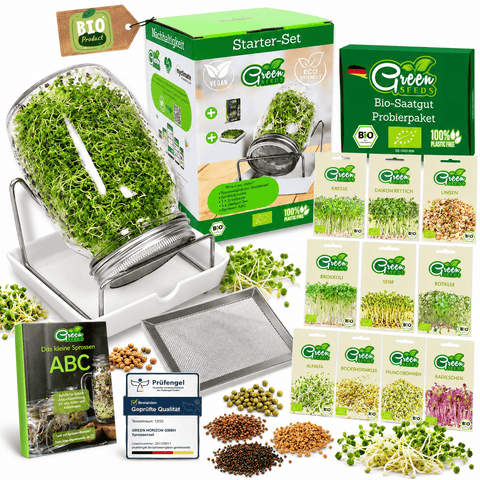
If you'd also like to grow microgreens later, use the cress sieve: it works without soil – the guide Microgreens on the windowsill shows how. You'll find a suitable sprouting jar and organic sprouting seeds in our shop.
Organic broccoli seeds for sprouting
Sprouting jar with ceramic tray and cress sieve
Why are specialised seeds so important for sprouts?
According to Ökolandbau.de, seeds for sprouts and microgreens are produced under hygienic conditions and should be free of contaminants and pathogens. That sets them apart from ordinary garden seeds, which are not intended to be eaten as sprouts.
Seeds from specialist retailers
The German Federal Centre for Nutrition also advises buying seeds for sprouts from specialist retailers rather than using self-collected seeds or seeds intended for the garden.
Important
Nightshades such as potatoes, tomatoes, peppers, chillies and aubergines contain toxins such as solanine and must not be eaten as seedlings or sprouts. Only use seeds that are expressly sold for sprouts and microgreens.
Pulses have a special feature too: seedlings of peas, beans and lentils should be blanched for at least two minutes or briefly cooked along with the dish before eating. Broccoli sprouts are usually eaten raw. If you belong to an at-risk group, such as pregnant women, young children, older people or people with weakened immune systems, you should, according to the food authority LAVES, avoid fresh sprouts or only eat them sufficiently heated. Find out more in the guide Which sprouts should you not eat raw?.
What do broccoli sprouts taste like and how do you use them in the kitchen?
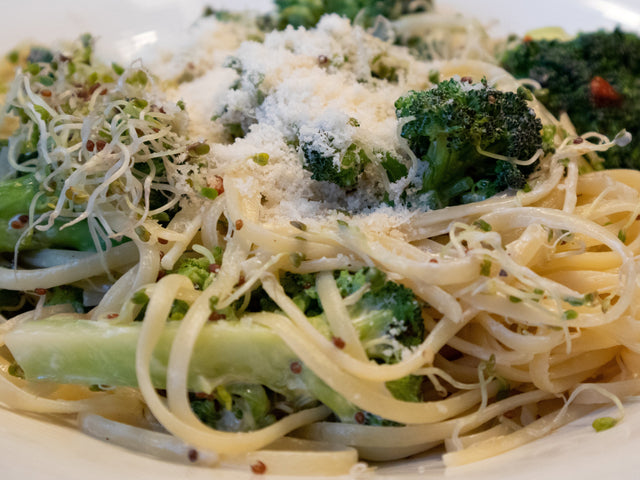
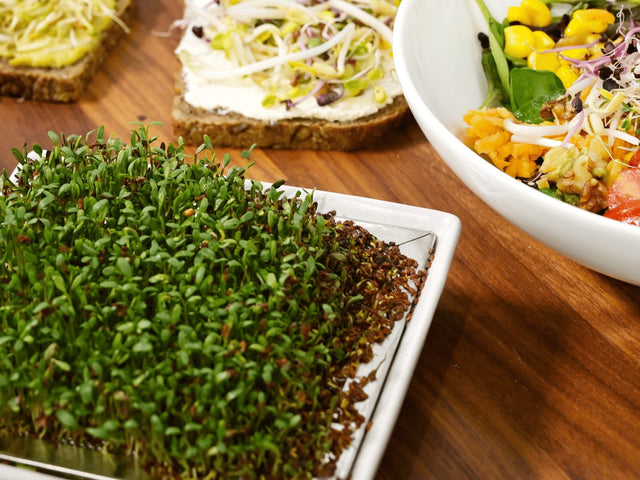
Broccoli sprouts are great as a topping for soups, salads and bowls and as a sandwich topping. They bring a crunchy texture and a subtle cabbage-like note that combines well with milder ingredients without overpowering the flavour.
It's best to sprinkle them raw over finished dishes just before serving, so they stay fresh. If you use the whole broccoli, you can also take inspiration from classic broccoli recipes: both the florets and the stalk can be used, for example in a cream soup, a potato and broccoli bake or a raw salad with carrots, peppers, apples and sunflower seeds. You'll find more ideas in the sprout recipes on our blog.
Conclusion
Broccoli sprouts are easy to grow in a sprouting jar as long as you stick to the dark phase in the first few days and rinse twice a day. After about three to seven days they're ready to harvest and make a crunchy topping for many dishes. If you let them grow longer, you can turn them into microgreens in the cress sieve. The key to a good result is special sprouting seeds, not ordinary garden seeds.
Recipe video: pasta with broccoli sprouts
Go to the recipe: Pasta with broccoli and broccoli sprouts
Frequently asked questions about broccoli sprouts
How long do broccoli sprouts keep?
After harvesting, rinse them one last time, drain well and store in the fridge. It's best to eat them within a few days.
Can you eat broccoli sprouts raw or should you blanch them briefly?
Broccoli sprouts are usually eaten raw. Blanching is mainly recommended for seedlings of pulses such as peas, beans and lentils. However, according to the food authority LAVES, pregnant women, young children, older people and people with weakened immune systems should avoid fresh sprouts or only eat them sufficiently heated.
Sprouting jar vs. other growing methods: which is easiest?
For broccoli as a dark germinator, a sprouting jar works well because it's easy to keep in the dark and simple to empty out and refill for rinsing. For microgreens, the cress sieve is the better choice.
What's the difference between seedlings, sprouts and microgreens?
Seedlings are the first visible stages after the seed has swollen, with a radicle and a shoot. As soon as the first seed leaves appear, they're called sprouts, which are ready to harvest after a few days. Microgreens grow for one to three weeks until at least two green leaves have formed in addition to the seed leaves, and are then cut just above the root.
Why should broccoli sprouts be kept in the dark for the first few days?
Broccoli is considered a dark germinator and should be kept in the dark or in the fridge for the first few days. After that, it continues to grow in a bright spot out of direct sunlight.
Sources


