











Making sauerkraut at home: a guide using a fermentation jar


How do white cabbage, salt and a little patience turn into sauerkraut that keeps for months? The answer is lactic acid fermentation, and you are in control of it right there in the jar. Two ingredients, a suitable container and a few rules on salt quantity, temperature and time are all it takes to make the result safe and predictable. If you want to try making your own sauerkraut, you don't need a specialist lab, but you do need to understand what is actually happening in the jar and to be able to tell when a ferment is fine and when it isn't.
At a glance
- All you need for sauerkraut is white cabbage and salt, with the salt making up 1 to 2 per cent of the cabbage weight
- At 18 to 20 °C the cabbage is fully fermented after about 14 days, and you can taste the first sourness after just 3 to 4 days
- A grey film is usually kahm yeast and should be skimmed off regularly
- Sealed and refrigerated, the finished sauerkraut keeps for several months
What actually happens when white cabbage ferments?
During fermentation, lactic acid bacteria convert the sugar in the cabbage into lactic acid. In the early phase, the salt holds back unwanted bacteria until the increasingly acidic environment takes over this job on its own. This turns raw cabbage into a sour food that keeps well, without any heat or vinegar.
Good to know
Fermented vegetables are not suitable for everyone. During fermentation, the amino acid histidine is converted into the messenger substance histamine. According to the German Federal Centre for Nutrition (BZfE), anyone with histamine intolerance should avoid sauerkraut and other fermented vegetables.
What equipment do you need for sauerkraut in a jar?
To get started, a clean preserving jar with a swing-top or screw-top lid is enough, along with a mandoline for slicing thin strips. If you ferment regularly, you'll benefit from a fermentation crock with a water channel, which lets gases escape and reliably keeps oxygen out.
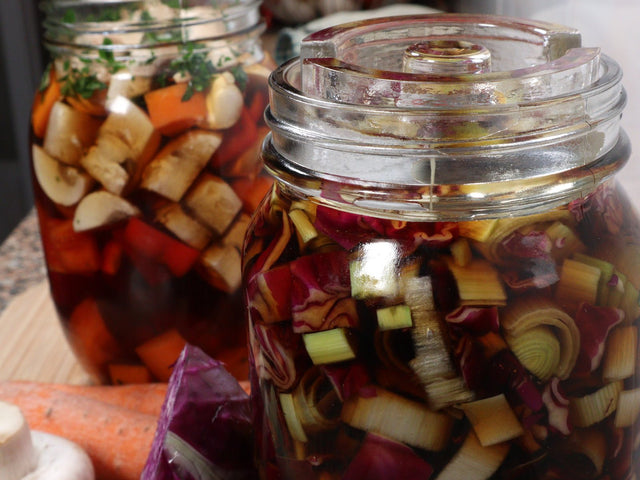
Preserving jars are good for small quantities and your first attempt. A crock with a water channel is worth it as soon as you ferment larger quantities or more often, because the water in the channel acts as a gas lock without letting air in from outside. Important with both options: the vegetables must stay completely covered with liquid, because lactic acid bacteria don't like oxygen. A fermentation jar with matching weights does exactly this job, with the weights reliably keeping the cabbage under the brine.
What you need
- Fresh white cabbage, as firm and undamaged as possible
- Non-iodised salt without anti-caking agents or additives
- A large jar or fermentation crock with a swing-top, screw-top or fermentation lid
- A mandoline or sharp knife for thin strips
- A weight to keep the cabbage under the brine
- Clean hands or a potato masher for kneading and pressing down
Fermentation jars, set of 2, with fermentation lids and glass weights
Fermentation weights, set of 2
How much salt does sauerkraut really need?
The right amount of salt is 1 to 2 per cent of the cabbage weight. The salt has a clear function: it stops unwanted bacteria from growing until the acid that forms takes over this job by itself. Too little salt therefore increases the risk of unwanted germs. The instructions for GÄRMEISTER fermentation salt use 2 per cent as a rule of thumb.
Example: for 1 kilogram of trimmed white cabbage, you need 10 to 20 grams of salt. The Max Rubner Institute calculates six kilograms of thinly sliced cabbage for a 5-litre fermentation crock, so you fill a fermentation jar with correspondingly less. If there is too little of the cabbage's own liquid in the jar after filling, the German Federal Centre for Nutrition recommends topping up with a little boiled and cooled salt solution so that the cabbage stays completely covered.
Fermentation salt without iodine or anti-caking agents
How does it work, step by step?
The process breaks down into slicing, kneading, filling and weighing down. The key thing is that enough brine comes out and that the cabbage ends up completely under the liquid, with no trapped air bubbles.
-
Slice the cabbage
Trim the white cabbage, cut it into quarters, remove the core and slice it into fine strips with the mandoline. -
Knead with salt
Mix the cabbage with the calculated amount of salt and knead or pound it vigorously until juice comes out. -
Leave to rest
After around 60 minutes, enough brine will have come out to work the cabbage and liquid together. -
Fill and press down
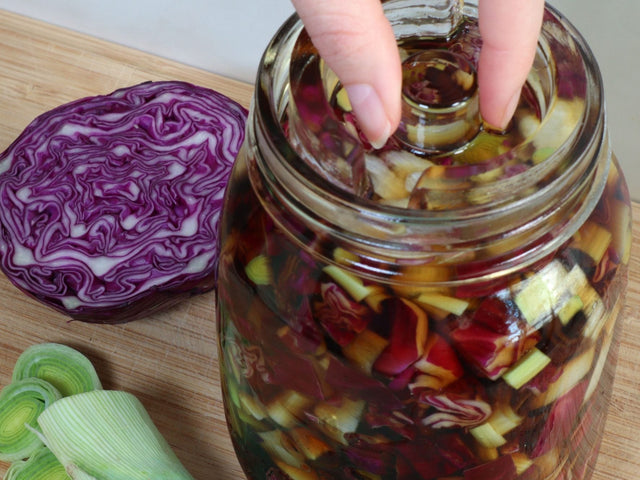
Fill the jar or crock with the cabbage and brine a little at a time, pressing it down firmly with your fist again and again so that no air bubbles remain. Only fill it high enough that the weight still fits on top. -
Weigh down and cover
Put a weight on top so that the cabbage and weight are completely covered by the brine. If there isn't enough liquid, top up with boiled and cooled salt solution. -
Seal
With a fermentation crock, fill the water channel; with a jar with a fermentation lid, use the airlock, or simply rest the lid loosely on top so that gas can escape.
Tip
You'll find more basics about fermenting in the Fermenting ABC. Suitable fermentation salt without iodine or anti-caking agents ensures that the fermentation isn't disrupted.
How long does fermentation take and how can I tell how it's going?
At 18 to 20 °C, the batch is fully fermented after around 14 days, and you can taste the first sour notes after just three to four days. A visible sign that fermentation is under way is small rising bubbles; fermentation is considered complete once no more bubbles form.
In the first phase, it's best to work at room temperature within the range given. Fermentation is faster when it's warmer and slower when it's cooler, and in both cases the flavour changes too. The longer you leave the batch, the more sour the sauerkraut becomes, and the longer it keeps afterwards.
Important when moving it to the fridge
Before a fermentation crock with a water channel goes into the fridge, the water must be removed from the channel. As it cools, a vacuum forms in the crock, which would otherwise suck all the water from the channel into the crock.
Kahm yeast or mould: what to do if something forms on the surface?
A thin grey film on the surface is usually kahm yeast and no reason to throw the batch away. It forms at the surface, where oxygen is present, and according to the German Federal Centre for Nutrition it should be skimmed off regularly.
Mould looks different: a fuzzy or coloured growth, for example green or black, is no longer a thin grey film. Skimming it off is not enough; if in doubt, throw away the whole batch. The basic protection against both is the right amount of salt at the start and brine that keeps the cabbage and weight completely covered at all times, because exposed areas dry out and give unwanted germs somewhere to take hold.
| Problem | Possible cause | What to do |
|---|---|---|
| Thin grey film | Kahm yeast at the surface | Skim off regularly and let fermentation continue as normal |
| Fuzzy, coloured growth (green, black) | Probably mould | If in doubt, throw away the whole batch |
| Cabbage sticking out of the brine | Too little liquid or the weight has slipped | Top up with boiled, cooled salt solution and reposition the weight |
| No more bubbles | Fermentation complete | The sauerkraut is ready, store it somewhere cool |
| Channel water runs inside when cooling | Vacuum as it cools | Remove the channel water before moving to the fridge |
How should you store the finished sauerkraut?
Once the sauerkraut is sour enough, the sealed jars go into the fridge. According to the German Federal Centre for Nutrition, fermented vegetables keep there for eight weeks to six months.
If you fancy some variety, you can use a similar technique to ferment other vegetables, such as brine-fermented cucumbers. For these, you make a 3 per cent salt solution, i.e. 30 grams of salt per litre of water. According to the Max Rubner Institute, after about two weeks the cucumbers taste quite fermented, depending on the temperature, and after three to four weeks they are translucent and fully fermented. Here too, seal the jar so that excess gas can escape, for example with a loosely fitted screw-top lid or a swing-top lid that can open.
| Pros of a preserving jar | Pros of a fermentation crock |
|---|---|
| Inexpensive way to start with small quantities | Water channel reliably keeps oxygen out |
| Space-saving, suitable even if you have little worktop space | More practical for larger quantities and regular fermenting |
| Good for trying out different recipes |
You'll find further guidance on preparation in the Max Rubner Institute booklet (in German), which describes quantities and fermentation times for sauerkraut and brine-fermented cucumbers in detail. If you'd like to explore more equipment, take a look at our fermenting accessories.
Conclusion
Making your own sauerkraut is essentially a simple process: white cabbage, the right amount of salt and enough time at a moderate temperature are all you need. Three points are key to a safe result: the cabbage must stay completely under the brine, a grey film is usually harmless kahm yeast and no cause for concern, and when moving a fermentation crock to the fridge, the channel water must be removed first. If you follow these basic rules, you'll get a ferment that turns out reliably and keeps for months.
Frequently asked questions about making sauerkraut
How long does homemade sauerkraut keep?
Sealed and stored in the fridge, fermented vegetables keep for eight weeks to six months, according to the German Federal Centre for Nutrition. The longer the fermentation lasted beforehand, the more sour the sauerkraut and the longer it keeps.
Can I ferment sauerkraut in a normal preserving jar instead of a fermentation crock?
Yes. Preserving jars are good for a first attempt and small quantities. If you ferment regularly, special fermentation crocks with a water channel are more practical, because they let gases escape while keeping oxygen out.
Does sauerkraut get more sour with a longer fermentation time?
Yes. The longer the lactic acid fermentation runs, the more sour the sauerkraut becomes and the longer it keeps. At 18 to 20 °C, it is ready after about 14 days, and you can taste the first sourness after just three to four days.
How can I tell whether it's kahm yeast or mould?
Kahm yeast appears as a thin grey film on the surface and should be skimmed off regularly. A fuzzy or coloured growth is more likely to be mould; if in doubt, throw away the whole batch.
Who should avoid homemade sauerkraut?
During fermentation, the amino acid histidine is converted into the messenger substance histamine. According to the German Federal Centre for Nutrition, fermented vegetables are therefore off the menu for people with histamine intolerance.
Sources
- Max Rubner Institute: booklet with sauerkraut and brine-fermented cucumber recipes (PDF, in German)
- German Federal Centre for Nutrition: Fermenting freshly harvested vegetables (in German)
- GÄRMEISTER fermentation salt: instructions and the 2% salt rule
- German Federal Centre for Nutrition: How long food keeps (in German)


